Showing posts with label Photoshop. Show all posts

Tuesday, March 23, 2010

DNA Sequencing, Not Really Explained (with pictures)

For fun, and because we needed a few shots for some publicity materials, I hauled the Sony Monster in to the lab last week. Apart from a few arty shots of my colleagues, which I won't post here, I spent most of the time taking photos of interesting equipment, at strange angles. As one does. And then processing the heck out of them, a task made easier, more enjoyable, and much, much faster by the combined virtues of (a) a new laptop with Intel Core i7 processors (what?), and (b) an upgrade to Photoshop CS4, all the way from the now-stodgy-looking CS2.

Honestly, I know what it all does, really.

Anyway, in lieu of a "real" blog post full of pithy and insightful commentary (yes, yes, I know, that's definitely not what you've come to expect here, is it?), I give you: a quick guide to some of the lab widgets. In one part. With captions. Do feel free to clickety-click on the photos, if you'd like to see them a little bit larger.

Here's part of the lab - for reference, the whole operation is about 15 times the size of this aisle:
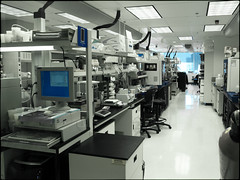
Lab

Right. First, we have an Applied Biosystems 9700 thermocycler, essentially a programmable machine that changes the temperature of teeny, tiny test tubes in a predictable way. Its primary use is for taking vanishingly small amounts of DNA, and making "carbon copies" of them via the famous, Nobel-Prize-Winning technique known as the Polymerase Chain Reaction. One application is "cycle sequencing", by which we take a piece of DNA and make copies of it in such a way that we can figure out its "genetic code" of those (warning - hackneyed description alert!) "building blocks of life", the nucleotide bases A, C, G and T.
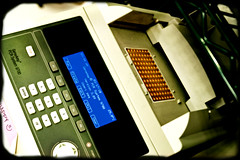
Thermocycler

Now, a pair of mighty Beckman Coulter BioMek NXP robots, used for pipetting 96 tiny volumes of liquid at a time:
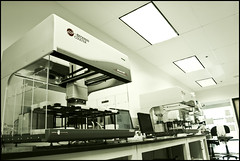
Biomek NXP times two

One thing we use those for is to "clean up" DNA sequencing reactions that come out of the aforementioned thermocyclers. These buffed, polished and waxed reactions then get loaded into an instrument that separates each reaction down a teeny, tiny, skinny little capillary filled with a gel substance. Count carefully, there really are 96 of them:

Capillary Array

This is fabulous technology, and similar in many respects to the methods used to complete the Human Genome Project. Nowadays, we have higher-throughput instruments, that generate DNA sequence at rates approaching a million times faster, such as this rather unprepossessing looking Applied Biosystems SOLiD (version "3 plus", in case you were wondering):

Applied Biosystems SOLiD

Yes, it really is big, and yes, it really does have its own computer nodes underneath it - the panels are off to allow some of the heat to escape.

So there you go, the cook's tour around a part of the lab, conveniently located across the hall from my office, just far enough away that the people who work in it don't have to worry about me actually pressing any buttons or tripping over anything. The sharp-eyed among you will also notice that in the first photo, everybody was clearly hiding from me. I like to believe it was because I was holding a camera, but you never know.

Friday, February 29, 2008

My own private art gallery

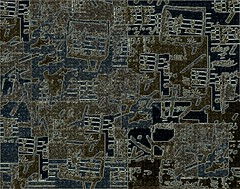
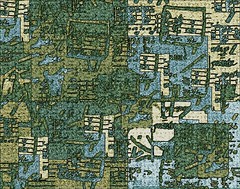
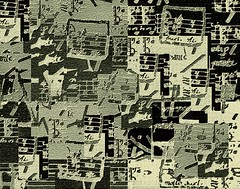
As I noted earlier, I've been thinking of dressing up the stark and barren wildernesses that are the walls of my office. A hunt around in the dark void that is the space under the stairs where outdated artwork, the odd exercise machine, and the luggage are all kept revealed absolutely nothing useful, unless you count dodgy floral prints and a beer poster or two. So, on to plan B, which was asking you lot for advice. After receiving a large number (note 1) of very useful (note 2) suggestions, I've decided, for now anyway, to put the following bits of my own digital art on my wall (thanks, Debi, for the encouragement).

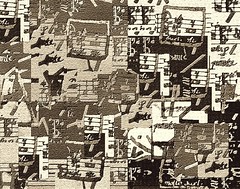
the lost manuscript
Some kind of music collage multimedia thing.

music_art_quilt
The same thing after extensive Photoshoppery monkeyshines.

Printed at 8 and a half by 11 inches with a cheap HP inkjet on matte brochure paper, and displayed in frameless glass picture mounts from the local dollar store, they look rather attractive but a bit small and lost. It's a start, though. My co-workers have very kindly hidden their confusion and made only polite noises so far (at least in my presence).

I've since added these two, which the discerning of eye will realize are simply slightly processed negatives of the others:

negative 1

negative 2

Actually, I reduced the contrast on the last one and applied a bit of warming filter, to make it a bit less stark black and white than what's shown here, but you get the idea, I think.

All of these were derived from this awful piece of, and I use the term loosely, multimedia art, which I made in late 1987 or possibly early 1988:

Untitled (1986)
Paper, markers, crayon, paint and glue.


Next up: photographs. Of birds' nests, rocks, fence rails, flowers, and the like. You've been warned.


Note 1: not.
Note 2: not.